


In a bold declaration at CES 2026 in Las Vegas, Hyundai Motor Group unveiled its Hyundai robotics strategy. This marks a major push into human‑centered robotics that could reshape manufacturing, logistics, and everyday life.
Under the theme “Partnering Human Progress,” the South Korean automotive giant laid out a roadmap to bring robots out of research labs and into practical, real-world roles alongside humans.
A Human‑Centered Vision for Robotics
At the heart of Hyundai’s announcement was an overarching goal: robots should work with people, not replace them. The Hyundai robotics strategy emphasizes “co‑working robots” designed to assist in hazardous, repetitive, or labor‑intensive tasks, from auto manufacturing floors to facility management. These robots are not futuristic props. Hyundai is already demonstrating real units like Spot and Stretch, which are actively working in industrial settings.
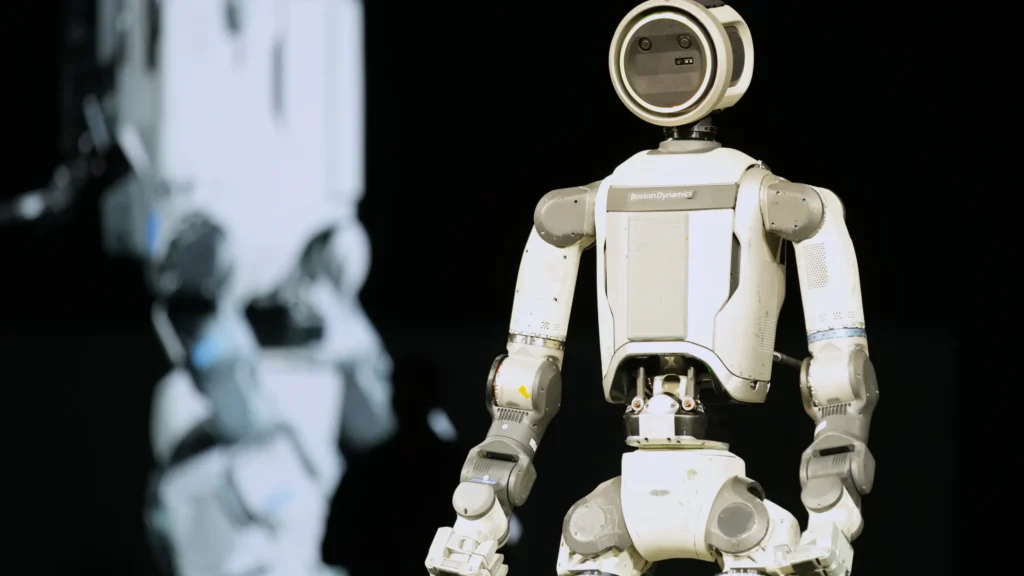
Central to this vision is a strategic partnership with Boston Dynamics, the robotics pioneer known for machines such as Spot and the humanoid Atlas. Hyundai’s plan integrates Boston Dynamics’ advanced robotics tech into its global manufacturing network. This will be through an end-to-end value chain that accelerates robot training, validation, production, and deployment.
Atlas and the Path to Factory Floors
One of the most striking demonstrations at CES was the public reveal of the humanoid robot Atlas. Operated remotely for its CES debut, Atlas walked, waved, and moved with surprising fluidity, signaling the leap from static prototypes to robots designed for real work. A production version destined for industrial applications will begin stationing at Hyundai’s Savannah, Georgia. Plant by 2028, first handling parts sequencing and later more complex assembly tasks by 2030.
The Hyundai robotics strategy doesn’t stop at individual demonstrations. The company plans to build a robot manufacturing plant and a Robot Metaplant Application Center (RMAC), where robots will be trained in real factory environments. This enables continuous learning cycles that use real-world data to make robots smarter and safer over time. A key requirement for broad industrial adoption.
Scaling Up With Physical AI and Services
Hyundai’s approach leans heavily into what it calls Physical AI, systems that merge physical robotics with sophisticated artificial intelligence to sense, decide, and act in uncontrolled environments. By embedding sensors and AI into robots across manufacturing, logistics, and other sectors, Hyundai expects to create a continuous improvement loop that benefits both product quality and worker safety.
A notable commercial twist in the Hyundai robotics strategy is the Robots‑as‑a‑Service (RaaS) model. Instead of one-time sales, companies can subscribe to robotics services that include maintenance, upgrades, and remote support. This will make advanced robotics more accessible for businesses of all sizes. Early adopters like DHL, Nestlé, and Maersk are already testing how this model works in real operations.
Conclusion: A Collaborative Future
The plans unveiled at CES 2026 signal more than flashy demos. Hyundai is pushing to produce up to 30,000 robots annually by 2028. A scale that could redefine industrial automation and open new markets beyond automotive manufacturing.
From streamlined logistics to energy and construction sites, these machines are being engineered to support, not supplant, human effort. By anchoring its strategy in collaboration, real-world performance, and continuous learning, Hyundai is not just building robots. it’s shaping a future where humans and machines together expand what’s possible.
Keep following Arabwheels for the latest insights into the automotive world.